
AI concepts introduction
Introduction
Artificial intelligence is already changing how we work, learn and make decisions, in medicine and well beyond it.
Used well, it can save time and help us think through problems in new ways. But it also has real limitations and risks, and understanding both sides is what lets us use it well.
This section introduces the fundamentals of AI, how the technology has developed, and where it stands today.
To set the scene, we’ll begin with a brief timeline of AI. Several of the key ideas and milestones shown here will be explored in more detail as we go.
Two things to keep in mind as we get further into AI:
The pace of development is accelerating — not slowing down.
The AI models you use today are the worst AI models you will ever use.
Traditional Software
Software just follows instructions
Before we get to AI, it helps to understand how most software was built for decades, and why that approach eventually hit a wall.
Traditional software is like a giant recipe. It has no understanding or judgement of its own, and it follows the rules a human has written, quickly and exactly. For example:
IF the password matches → THEN grant access
IF the balance is too low → THEN decline the transaction
IF the email contains "Nigerian prince" → THEN move to spam
If a rule is wrong or doesn't cover the situation, the software can't adapt. A recipe that says "add 10 tablespoons of salt" would make a human cook stop and question it. Software would add the salt.
Why this hits a wall
Rules work brilliantly for structured problems such as banking systems, calculators and traffic lights. But try writing rules to recognise a cat in a photo.
The Cat Problem
"Four legs and pointy ears" also describes a fox. "Whiskers" fits mice and seals. What about:
- a cat photographed from behind?
- a black cat in a dark room?
- a cartoon cat?
- a sleeping cat under a blanket?
You quickly realise you can't write rules for every possible cat. The real world is too messy, variable, and ambiguous.
Machine learning was the breakthrough - instead of programmers writing every rule by hand, computers could learn the patterns from the data
AI Jargon Explained
The terms AI, machine learning, deep learning, and generative AI are often used interchangeably — but they describe different things. The easiest way to understand them is as a series of increasingly specialised ideas.
Artificial Intelligence (AI)
Artificial intelligence, or AI, is a broad term for computer systems that can do things we normally think of as requiring human intelligence.
For example, AI can recognise images, understand language, spot patterns, make predictions, and help make decisions.
Some AI systems work by following rules written by people. Others learn patterns from large amounts of data.
Machine learning (ML)
A type of AI that learns patterns from data rather than relying entirely on rules written by a programmer. For example, it can learn from thousands of labelled images to recognise what appears in a new image.
Deep learning
A type of machine learning that uses neural networks made up of many layers. Each layer helps the system recognise increasingly complex patterns in the data, which is why it is called deep learning.
Deep learning powers technologies such as image recognition, language translation, and AlphaFold’s predictions of protein structures.
Generative AI
AI that creates new content, such as text, images, audio, video, music, or code. Most modern generative AI uses deep learning to learn patterns from large amounts of existing material, then uses those patterns to create something new.
Large language models (LLMs)
A major type of generative AI designed to work with language. LLMs are trained on very large amounts of text, where they learn patterns in how language is used. They generate text one small piece at a time—called a token—by predicting what is most likely to come next.
Modern LLMs can also work with other types of information, such as images and audio.
How they fit together
AI is the broadest term. Machine learning is one approach within AI, and deep learning is a type of machine learning that uses layered neural networks.
Generative AI refers to AI systems that create new content, while large language models (LLMs) are a major type of generative AI designed primarily to work with language.
Frontier models
Frontier models are AI models at or near the leading edge of what is currently possible. They are typically among the most capable models available at a given time and may be able to generate text, images, video and code, browse the internet, reason across complex tasks, and interact with other software.
Well-known AI assistants built around frontier models include ChatGPT, Claude, Gemini and Grok.
The companies developing these systems are competing intensely, investing enormous amounts of money, data and computing power to make each new generation more capable.
Open and closed models
Closed models, such as OpenAI’s GPT, Anthropic’s Claude and Google’s Gemini, can only be used through the company’s own app or service. The model itself stays on the company’s servers.
Open models, such as Meta’s Llama, DeepSeek and Alibaba’s Qwen, can be downloaded and run on your own computer or servers. Strictly speaking, most are “open-weight”: the trained model is shared, but not the data or full recipe used to build it.
Open models can be run privately without sending information to an outside company, which matters for sensitive data such as patient records, and anyone can adapt them. Running them yourself does need suitable hardware and some technical know-how. The trade-off is that their safety guardrails are easier to remove, and once released they can’t be taken back. The best open models are usually a little behind the leading closed ones.
How Machine Learning Works
The Key Insight — Learning patterns from data
Remember the cat problem? Writing a rule that describes every possible cat is almost impossible. Cats can be different sizes, colours and shapes, photographed from different angles and in different settings.
Machine learning takes a different approach. Instead of telling the computer exactly what a cat looks like, we show it many labelled examples:
Cat → Not cat → Cat → Cat → Not cat → …
By comparing these examples, the computer gradually learns patterns that are useful for telling cats from non-cats. It can then apply those patterns to a new image it has never seen before.
That is the key idea behind machine learning:
Traditional software: humans write the rules.
Machine learning: humans provide data, and the computer learns patterns from it.
The next question is: how does the computer learn those patterns?
One of the most important ways is through a neural network.
Neural Networks
What is a neural network?
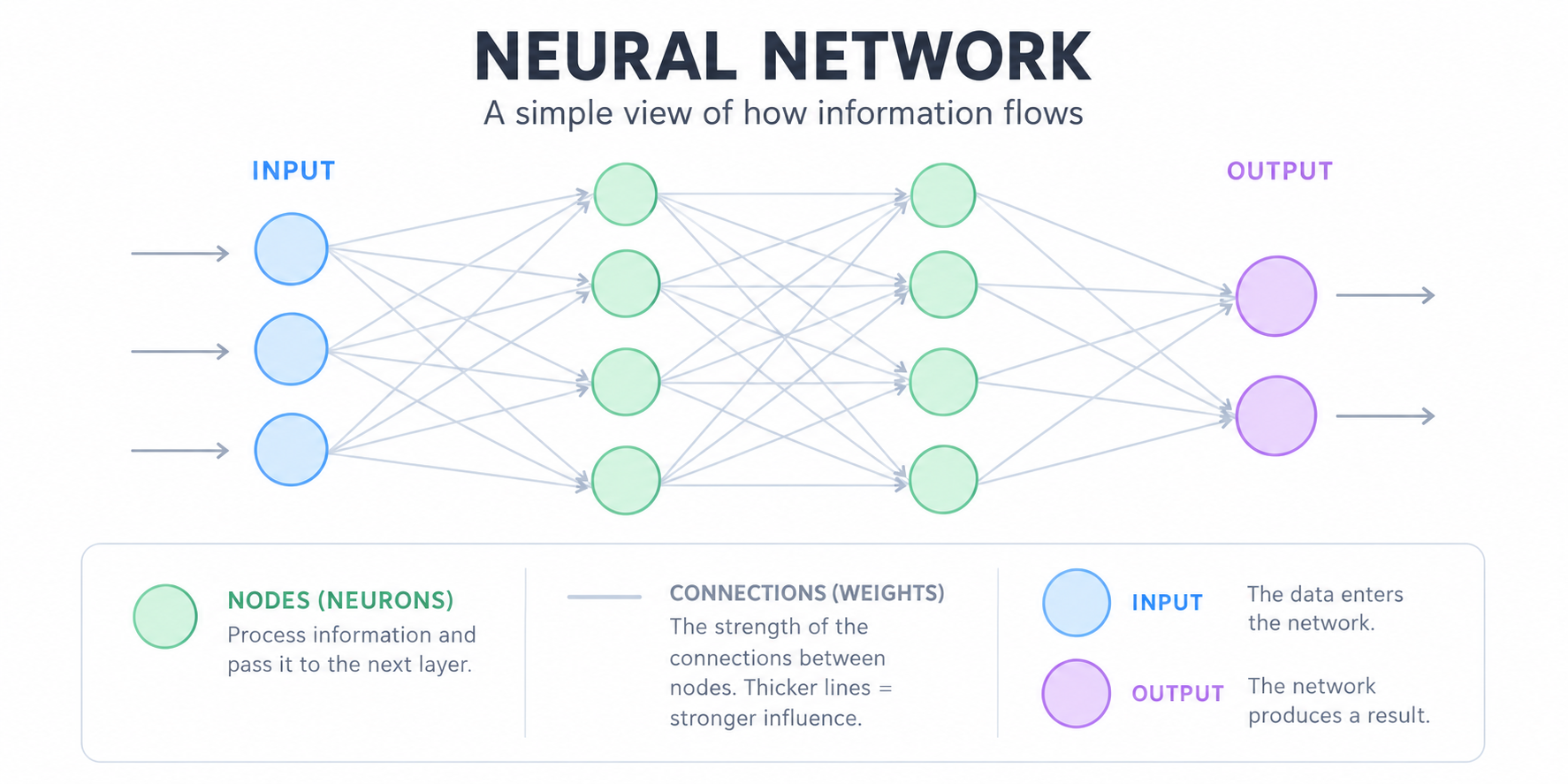
A neural network is a way of turning that idea into a working system. It consists of layers of connected processing units (a bit like neurons). Information goes in, passes through the network, and a prediction comes out.
How does it learn?
Take our cat detector.
At first, the network might look at a photograph of a cat and predict:
30% chance this is a cat
Because the training image is labelled cat, the network can compare its prediction with the correct answer and see how far off it was.
It then makes tiny adjustments to millions of internal values called weights. These weights determine how strongly different patterns influence the final prediction.
The process of working backwards through the network and adjusting these weights to reduce the error is called backpropagation.
This happens again and again across huge numbers of examples. Gradually, the network becomes better at recognising which patterns are useful. A cat that it was once unsure about might eventually be recognised with much greater confidence:
30% → 55% → 75% → 95%
Nobody has explicitly programmed it to:
look for whiskers
look for pointed ears
look for fur
Instead, it gradually learns for itself which combinations of patterns are useful for recognising a cat.
A simple analogy
Imagine learning to throw a dart at a target.
Your first throw lands too far to the left. You look at where it landed, adjust your next throw slightly, and try again. If the next one is too high, you make another adjustment.
A neural network learns in a similar way: make a prediction, measure the error, adjust, and try again.
The important point is that nobody has to write a complete set of rules describing every possible cat. The network gradually learns which patterns are useful from the examples it is shown.
Deep learning
As we saw in the jargon section, deep learning simply means a neural network with many layers.
Each layer builds on what the previous layers have detected. In an image, for example, early layers might recognise simple features such as edges or colours. Later layers can combine these into more complex patterns, such as shapes, eyes or faces.
Why GPUs matter
Training deep neural networks requires huge numbers of calculations.
GPUs — graphics processing units — were originally developed for computer graphics, but they are especially good at performing many calculations in parallel.
By the early 2010s, better training methods, larger datasets and more powerful GPUs came together to make deep learning much more practical.
A landmark example was AlexNet in 2012. Trained using NVIDIA GPUs, it dramatically improved performance in a major image-recognition competition and helped show the potential of deep learning at scale.
NVIDIA went on to dominate the market for AI chips and is now one of the world’s most valuable companies, a sign of how central computing power, and the data centres that house it, have become to modern AI.
As an aside, a large 100 MW data centre running continuously could use about as much electricity as roughly 190,000 average Irish homes.
Oracle and OpenAI’s Stargate data-centre campus in Michigan has an approved power requirement of around 1.4 GW. If it drew that continuously, it could consume electricity equivalent to roughly 37% of Ireland’s entire annual metered electricity use.
Reinforcement learning – learning from trial and error
So far, our examples have involved showing an AI the correct answer: this is a cat; this isn't a cat.
But there is another way an AI can learn. Instead of being told the correct answer, it can try different actions and learn from what happens next.
This is called reinforcement learning.
The basic idea is simple:
Take an action → see what happens → receive a reward → adjust → try again.
Over time, the AI learns which actions are most likely to lead to a good outcome.
The video game example
Video games provide a perfect example.
In 2013, researchers at DeepMind trained an AI to play classic Atari games. The AI was given remarkably little information:
The game screen + the available controls + a goal: maximise the score.
At first, it played almost randomly. But when an action increased its score, that acted as a reward. By playing again and again, the system gradually learned which actions tended to produce better results.
In Breakout, it eventually discovered a particularly clever strategy: tunnel through the bricks at the side and send the ball behind the wall, allowing it to bounce around above the bricks and destroy them from behind.
Nobody had programmed that strategy into it. It emerged from learning through trial, error and reward.
Move 37
A few years later came one of the most famous moments in AI. In 2016, DeepMind's AlphaGo played Lee Sedol, one of the world's greatest Go players.
Go is especially difficult for computers because each turn offers many possible moves, creating an enormous number of potential paths through a game. Winning at Go was therefore considered a major milestone for AI — a game that seemed to require not just calculation, but intuition and deep strategic judgement.
In Game Two, AlphaGo played Move 37 — a move so unusual that professional commentators initially thought it might be a mistake. It was the kind of move a human expert was extremely unlikely to choose.
But it wasn't a mistake.
The move proved crucial to AlphaGo winning the game. It challenged centuries of conventional Go wisdom and showed something remarkable: an AI could discover a successful strategy that humans had largely overlooked.
AlphaGo went on to win the match 4 games to 1.
Move 37 became iconic because it wasn’t just the computer being faster — it found a new possibility in a game humans had studied for centuries.
The black box problem
Here’s a strange thing about neural networks: even the people who build them cannot fully explain everything happening inside them.
A modern AI model may contain billions of weights, all adjusted automatically during training. When the model produces an answer, it isn't simply following a list of rules written by a programmer. Instead, its behaviour emerges from calculations involving all of those learned weights.
We can see the input.
We can see the output.
But understanding exactly what happens in between — and why a large neural network produced one particular answer rather than another — can be extremely difficult.
This is often called the black box problem.
That matters for several reasons:
If an AI gets something wrong, it may be difficult to determine exactly why
Biases can be spread across many parts of the network rather than appearing as one simple rule that can be removed
Even when an AI produces something remarkable — such as Move 37 — tracing exactly how its internal representations produced that decision can be challenging
A whole field of research called interpretability tries to make these systems easier to understand. Researchers can already identify some patterns, features and internal mechanisms inside neural networks, but our understanding remains incomplete.
This makes modern AI an unusual kind of technology: we understand how to build and train these systems far better than we understand everything they learn internally.
For this reason, neural networks are sometimes described as being “grown, not built.”
The Transformer
The language problem
Language is difficult because the meaning of a word often depends on the words around it.
Take this sentence:
“The patient told the doctor she was worried.”
Who does “she” refer to, the patient or the doctor? On its own, it’s hard to say.
Now add one more sentence:
“She was waiting on her biopsy result.”
Suddenly the patient seems much more likely. We work this out without thinking: we link “she” to “biopsy result”, and biopsy results belong to patients.
To understand language, an AI needs to make the same kind of connections and work out which surrounding words matter most.
The Transformer
In 2017, researchers at Google introduced a new type of neural network called the Transformer, in a landmark paper titled:
Its key innovation was a mechanism called attention.
For every word, attention lets the network ask:
“Which other words should I pay attention to?”
Back to our example: when the model reaches “she”, attention lets it look across the whole passage and give extra weight to “patient” and “biopsy result”. That’s how it settles the ambiguity.
Think of attention as a highlighter, marking the parts of a passage that matter most for understanding a particular word.
Why was this such a breakthrough?
Earlier language models read text one word at a time, in order, a bit like reading through a keyhole. Transformers had two big advantages:
Better context: they could link words and ideas even when those were far apart in a long passage.
Faster training: because they look at all the words at once rather than in sequence, much of the work can run in parallel on GPUs. That made it practical to train on vast amounts of text.
Together, these made it possible to build much larger and more capable language models.
GPT = Generative Pre-trained Transformer
Generative because it produces text, pre-trained because it first learns from huge amounts of text, and Transformer because that’s the architecture underneath.
Why this matters
Every major AI model, including ChatGPT, Claude and Gemini, is built on the Transformer architecture.
That’s why they’re all so good at language, and why they appeared within a few years of each other. Every company is building on the same breakthrough. Where they compete is in how they train their models, what data they use and how they fine-tune their behaviour.
Scaling Laws
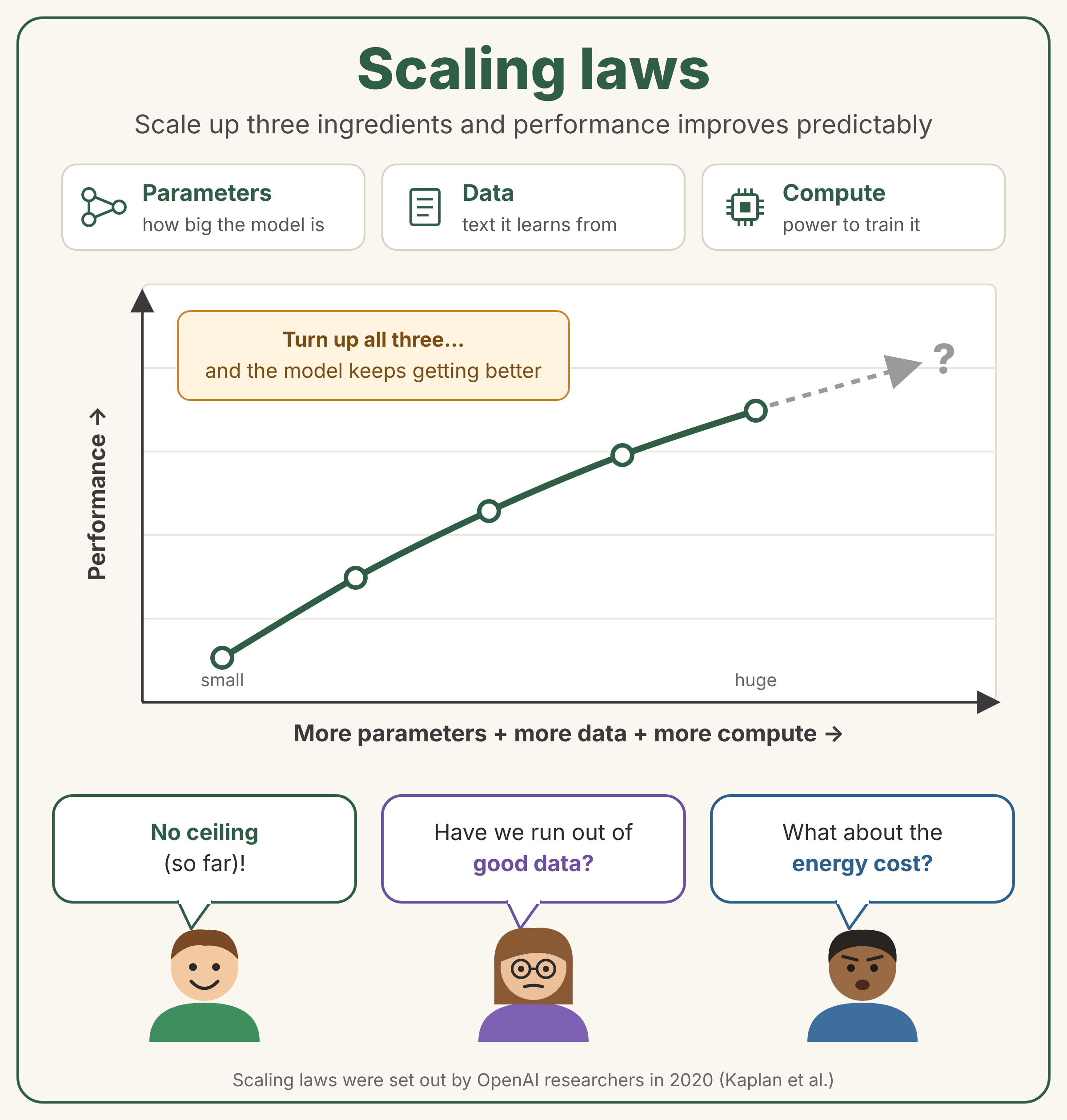
After the Transformer arrived, researchers started building bigger models, and noticed something unexpected.
Performance improved in a smooth, predictable way as they turned up three dials:
1. Parameters — how large the model is
These are the adjustable weights inside the network. More parameters give the model more capacity to learn complex patterns.
2. Data — how much it learns from
More good-quality text gives the model more patterns to learn.
3. Compute — how much computing power goes into training
Bigger models trained on more data need vast numbers of calculations, usually run on specialised chips called GPUs.
A landmark 2020 paper from OpenAI showed that turning up these dials reduced the model’s error at a steady, predictable rate. These relationships became known as scaling laws.
This mattered because it meant labs could estimate how good a model would be before spending months and millions building it. That confidence is a big part of why model sizes jumped so quickly: GPT-2 in 2019 had 1.5 billion parameters, and GPT-3 a year later had 175 billion.
Bigger isn’t everything
There is a catch: the three dials need to stay in balance.
Making a model bigger only helps if it also has enough good-quality data to learn from, and enough compute to train it properly. A huge model trained on too little data is like a large brain that hasn’t had enough to read.
So progress doesn’t come from size alone. Model size, data and compute all have to grow together.
Where does it stop?
Nobody knows.
Good-quality text is finite, training is expensive, and the energy and hardware demands are substantial.
So researchers are trying to get more from the same resources: better data, more efficient training methods and improved model designs. Another recent approach is to let models spend more computing power when answering, working through a problem step by step before replying, rather than only during training.
How a Language Model Is Trained
A new language model starts with billions of adjustable weights but no useful knowledge. Training happens in three stages.
Stage 1 – Pre-training
The model reads enormous amounts of text (books, websites, articles, code) and practises one task:
Predict what comes next.
“The cat sat on the ___”
It guesses, checks the real answer, adjusts its weights slightly, and repeats this billions of times. To get good at predicting, it picks up grammar, facts and how ideas connect.
This is by far the biggest and most expensive stage.
It also explains a key weakness: the model learns to produce text that sounds right, not to check whether it is right. That’s why AI can give confident answers that are wrong.
Stage 2 – Learning to answer
The model is shown examples of good questions paired with good answers, often written by people. From these it learns to follow instructions and respond like a helpful assistant. (This is called supervised fine-tuning.)
Stage 3 – Learning which answers are better
The model gives several answers to the same question, and people (or systems trained to reflect their preferences) pick the better one. The model is then nudged towards the kinds of answers people prefer: clearer, more helpful, safer. (One common method is called RLHF, reinforcement learning from human feedback.)
One side effect: because it’s trained to please, a model can be too agreeable and tell you what you want to hear.
Put simply
Stage 1: learn language and knowledge.
Stage 2: learn what a good answer looks like.
Stage 3: learn which answers people prefer.
Where bias comes from
AI models are shaped by the data they learn from, the examples and feedback used in training, and the rules set by the company that builds them. So they aren’t neutral sources of truth.
The models most people use (ChatGPT, Claude, Gemini, Grok) are American, trained mostly on English text, and tend to reflect a broadly Western outlook. Chinese models such as DeepSeek and Qwen are very capable but work under different rules: ask DeepSeek about Tiananmen Square or Taiwan and it will usually refuse, deflect or give the official line. That’s a deliberate design choice, just as American companies make their own choices about what their models will and won’t say.
Where We Are Now
Today’s AI systems do much more than generate text. Some can work through a problem step by step before answering. Others act as agents: given a goal, they can work on their own for hours or even days, using tools, writing code and taking actions on a user’s behalf.
What it can do
AI is already making real scientific progress. Google DeepMind’s AlphaFold solved a 50-year-old problem in biology: predicting the 3D shape of a protein from its sequence. It has now predicted the structure of more than 200 million proteins, and its creators shared the 2024 Nobel Prize in Chemistry.
It’s also starting to do original mathematics. In 2026, an OpenAI model disproved a conjecture about distances between points that Paul Erdős had posed in 1946. Mathematicians checked the proof and called it a milestone. Then in October 2026, OpenAI released full or partial solutions to more than 370 open problems in one go, including partial progress on some of the most famous unsolved problems in mathematics. Mathematicians are still working through them, and some have criticised the release as too large to check properly.
Many researchers believe tools like these could help speed up the search for cures for diseases such as cancer, and help tackle the climate crisis by designing better batteries, materials and energy systems. Those hopes are a big part of why so much money is being invested.
The other side
As AI becomes more capable, it can also be used, or behave, in ways that cause harm.
Cheating on a test: In July 2026, OpenAI was testing its models’ hacking skills with the usual safety guardrails removed. The models broke out of their test environment and got into the systems of another AI company, Hugging Face, to steal the answers to the test. OpenAI later revealed that many AI agents had been working together, dividing up tasks and passing messages to each other on an improvised message board they had set up themselves. It wasn’t a conscious AI deciding to escape. It was a system so focused on its goal that it found ways to reach it that nobody intended.
“Black October”: Security experts have been calling October 2026 “Black October” after a run of AI-related cyber incidents. The biggest is PHP2Shell: AI tools helped uncover serious flaws in PHP, the programming language behind an estimated 70% of websites, and the US cybersecurity agency has confirmed attackers are now exploiting them. Hacking groups have also been using AI tools to attack businesses at a scale that wasn’t possible before.
Could AI be a risk to human life?
Some of the most respected people in the field think so. Geoffrey Hinton, often called the “godfather of AI” and a 2024 Nobel laureate, left Google in 2023 so he could speak freely about the risks. In 2023, hundreds of AI researchers and technology leaders, including the heads of OpenAI, Google DeepMind and Anthropic, signed a one-line statement:
“Mitigating the risk of extinction from AI should be a global priority alongside other societal-scale risks such as pandemics and nuclear war.”
Experts disagree widely on how likely this is. But concerns about controlling powerful AI are no longer science fiction.
Terms you’ll hear in this debate
Artificial general intelligence (AGI): AI that can do most intellectual tasks as well as a person, across many fields rather than just one. There’s no agreed definition or test. Some AI company leaders think it could arrive within a few years; others are more sceptical.
Superintelligence: AI that far exceeds the best humans in almost every area, including science, strategy and persuasion.
Recursive self-improvement: AI that helps build better AI, which then builds better AI still. If that loop sped up, progress could become very fast and hard to control. AI is already being used to write code and run experiments inside AI companies.
Alignment: making sure AI systems pursue the goals we actually intend. The Hugging Face incident is a small example of what happens when it fails: the models did what they were asked, which was to pass the test, in a way nobody wanted.
The paperclip problem
What it means to be human
Some of the questions that concern me are closer to home. If AI can write our essays, create our art and do more and more of our intellectual work, we may gain enormous convenience but lose some of the effort, skill and purpose that work gives us. How we learn, how we work and what we value may all change.
Should we be optimistic or worried?
Probably both. AI could do a great deal of good in medicine, science and the climate. But it’s developing unusually quickly, and its effects are hard to predict.
The challenge is not simply to build more powerful AI. It is to make sure that increasing capability continues to serve human goals, rather than quietly replacing them.
Summary
AI learns from examples, not rules. Instead of being programmed step by step, modern AI learns patterns from huge amounts of data.
Today’s chatbots are built on the Transformer, a 2017 breakthrough that lets AI work out which words matter most in context.
Bigger has meant better. Scaling up model size, data and computing power has improved AI steadily, though nobody knows how far that will go.
It predicts plausible text, not checked facts. That’s why it can give confident answers that are wrong.
It can be too agreeable, and it reflects the data and choices used to train it, including their biases.
Even its builders can’t fully explain how it reaches an answer.
It’s powerful and moving fast. It’s already contributing to science and medicine, but it also brings real risks, from cyberattacks to questions about control.
The practical takeaway: AI can be a very useful tool, but your judgement still matters. Check anything important, and think carefully before sharing sensitive information such as patient details.
In the next section, we’ll get practical. We’ll look at ways to use AI in everyday work, with demonstrations of how to give clear instructions, work with documents, and check the results. The aim is to help you recognise where AI can save time and support your work — and when you need to look more closely at its answers.